
 By Dr. Kelly Sherman-Conroy
Associate Pastor, All Nations Indian Church
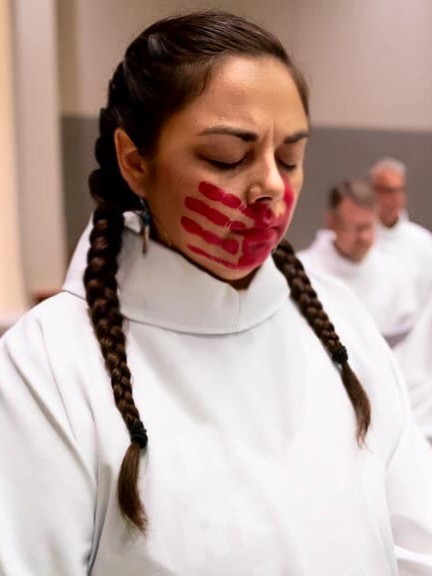
I stood alongside our youth and my friend and colleague, Brenda, at our Synod Assembly, to speak from the deep ache of our Native community. It wasn’t about statistics; it was about longing to be a whole Body of Christ. I talked about Missing and Murdered Indigenous Women and Girls. I didn’t just offer words; I offered ceremony. For me, that moment at the microphone was Eucharist. I shared what Eucharist means in my Lakota tradition. It is not just bread and wine. It is not confined to a church service or to a single moment. It is ceremony. It is relationship. It is the act of bringing someone back into the circle and making them present again through love, memory, and connection.
Eucharist in my Lakota way is about wholeness. Eucharist is what we do when we gather in prayer, when we remember those we’ve lost, and when we act in ways that restore balance and justice. It is a lived expression of kinship. The Eucharist says, “You are not forgotten. You still belong here.”
When I was offering ceremony at the microphone, I said that Native women make up less than one percent of Minnesota’s population, yet Missing and Murdered Indigenous Women and Girls account for eight percent of all missing women and girls in our state. That statistic is not just shocking; it is heartbreaking. Our missing beloveds and the statistics tell us what so many in our communities already know. Our lives are not treated with the same care.
After my offering, someone stood up and questioned why Native women were being centered.
That moment hurt. But what hurt more was what came next.
Nothing. 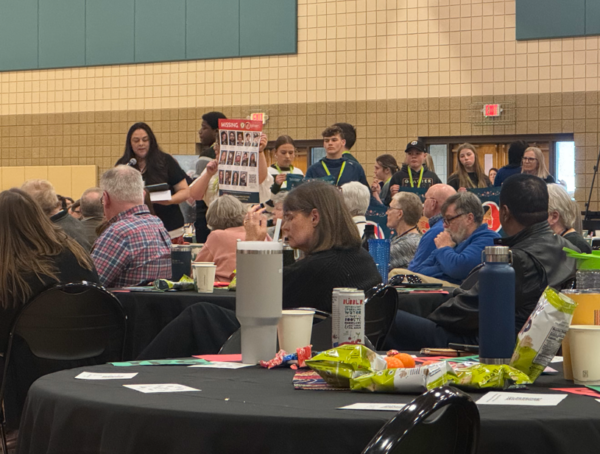
No one stood up. No one spoke out. There wasn’t a single voice of outcry from the memorial’s signers. Not one pastor stepped in. Not one friend said at that moment, “That isn’t right.” I stood there with my heart pounding, wondering if anyone would see what was unfolding. The silence became louder than the question itself. It felt like my grief was being asked to stand alone, to be put on display and be objectified. I kept scanning the room, hoping someone would meet my eyes, hoping someone in a room filled with friends and colleagues would speak to honor the ceremony I offered to the Assembly. But no one did.
It has taken me days to name that pain of isolation and loneliness. Not just because of what was questioned, but because of who stayed quiet. The silence was heavy. It spoke its own message.
Silence can communicate so much, depending upon context. There is a kind of silence that is sacred. The kind that holds space for grief, for the presence of God, for deep listening. There is also a kind of silence that wounds. The silence happens when truth is spoken into a space, and no one stands beside it and affirms it. There is a silence that happens when an act of harm is on public display, and no one interrupts. That kind of silence is not reverent; it is complicit in harm.
This is not about blame. It’s about what silence communicates.
When no one speaks up, silence reinforces the very invisibility I just named. It tells us that our stories are too uncomfortable, and that people seek comfort in silence at the expense of a beloved sibling. Our grief is too political. Our presence is too much. Silence leaves the weight of the moment on the shoulders of the already burdened.
What I needed in that moment wasn’t a flawless response. I just needed someone to say, “I see you. I’m here.” I needed someone to share the weight.
We talk about being the body of Christ. Paul writes, “If one member suffers, all suffer together.” That isn’t just a comforting idea. It’s a call to live differently. To listen actively. To step in when the moment is hard and the silence starts to close in.
When we talk about Eucharist from a Lakota perspective, we are talking about a way of being. It is not a once-a-week ritual. It is how we hold memory in our bones and live it through embodied action. It is how we bring our relatives close through prayer, ceremony, and justice. It is how we say with our whole lives, “You are not alone.”
Eucharist is an embodiment of justice. In both the Christian and Lakota traditions, it is not only something we remember, but also something we do. When Jesus said, “Do this in remembrance of me,” he was not asking for performance. He was inviting us into practice. Remembrance is not passive. It is love that moves and does. Justice takes shape in that practice. In my Lakota tradition, Eucharist is how we bring healing to what has been broken and belonging to those who have been pushed aside.
If we want to be a Church that truly remembers, then we must be a Church that responds, that shows up and speaks when others hesitate. That is Eucharist.
The Memorial mentioned in this blog post is RC2025 06 Memorial: Missing and Murdered Indigenous Women (MMIW). The Memorial was adopted and will be brought to the ELCA Churchwide Assembly in July 2025.