
Version en Español abajo
 By Juan Gonzalez
A furious storm came up, and the waves broke over the boat, so that it was nearly swamped. Jesus was in the stern, sleeping on a cushion. The disciples woke him and said to him, “Teacher, don’t you care if we drown?”
He got up, rebuked the wind and said to the waves, “Quiet! Be still!” Then the wind died down and it was completely calm.
He said to his disciples, “Why are you so afraid? Do you still have no faith?”
They were terrified and asked each other, “Who is this? Even the wind and the waves obey him!”
(Mark 4:37-41)
For many of us right now, life might feel like driving through a winter storm in the middle of the night with our kids in the back seat. We’re unsure how long it’s going to last. It’s difficult to see the road ahead, or the road in general. And it’s even more difficult to know what the best choice is to keep our family safe. Regardless, we might feel like we need to keep moving forward, stay calm, and pretend that we have everything under control.
Frustration builds quickly in times like this. Do we slow down? Do we pull over? Or do we keep moving? Should I say something? Or should I stay quiet? Thoughts race and there doesn’t seem to be a perfect answer. All the tension from wishing we had more control over the situation leaves us feeling discouraged and exhausted. Most of us don’t have the energy we feel we need right now.
In a storm, we don’t suddenly become better drivers. Instead, we watch the few feet of road we can see ahead of us, we turn the radio down, we remove distractions and focus on what’s most important: keeping ourselves and our families safe. What’s important to remember for parents who feel the need to “handle this well” is this: Give yourself grace, stay connected, and keep being present.
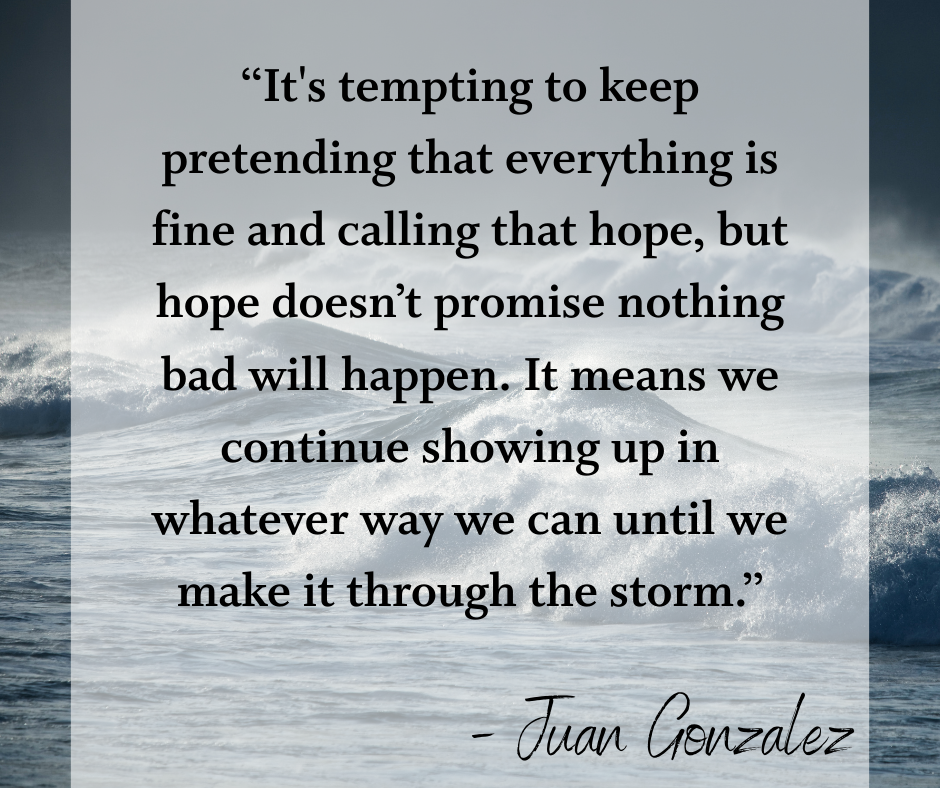
It’s tempting to keep pretending that everything is fine and calling that hope, but hope doesn’t promise nothing bad will happen. It means we continue showing up in whatever way we can until we make it through the storm.
When our kids sense the storm, and they almost always do, they don’t need an explanation as much as they need reassurance. Jesus is already in the boat before the storm begins. He calms the storm, but in doing so he reminds his disciples to ground themselves in the trust that comes from God when fear and uncertainty feel overwhelming. It’s ok for us to admit that we don’t have all the answers without handing our fear to our children. In times like this, it’s helpful to remind them of what is most important. That they are loved, they are not alone, and that we are here with them.
We don’t know how long the storm will last, but Jesus reminds us that it will not get the final word, even when all we have left is a shred of hope. If all you have energy for is keeping your hands on the wheel and keeping your eyes on the road, that is enough. If all you can offer your children right now is your presence, your love, and your care, that is faithful. Keep showing up. Show up afraid, heartbroken, frustrated, or exhausted if you have to, but keep showing up and it will be enough.
Holding on to hope doesn’t mean the storm will pass quickly. It means that we are committed to accompanying one another through it. Sometimes the most faithful thing we can do for our children is to keep going. Slowly, together, and trusting that even if it’s hard to see the road ahead, we can see just enough to take one more step.
—–
Our Minneapolis Area Synod Welcome Fund stands with our immigrant neighbors who are navigating uncertainty, seeking welcome, and longing for safety and community. By giving to the Welcome Fund, you help ensure that families are not facing life’s storms alone. Give to the Welcome Fund and support immigrant families as they move forward with dignity and hope.
Cuando No Podemos Ver El Camino: Carta abierta a los padres
Se desató una tormenta furiosa y las olas rompieron sobre el barco, casi inundado. Jesús estaba en la popa, durmiendo sobre un cojín. Los discípulos le despertaron y le dijeron: “Maestro, ¿no te importa si nos ahogamos?”
Se levantó, reprendió al viento y dijo a las olas: “¡Silencio! ¡Quietos!” Luego el viento se calmó y todo quedó completamente tranquilo.
Dijo a sus discípulos: “¿Por qué tienen tanto miedo? ¿Siguen sin fe?”
Estaban aterrorizados y se preguntaron entre ellos: “¿Quién es este? ¡Incluso el viento y las olas le obedecen!”
(Marcos 4:37-41)
Para muchos de nosotros ahora mismo, la vida puede parecer conducir a través de una tormenta invernal en mitad de la noche con nuestros hijos en el asiento trasero. No sabemos cuánto tiempo va a durar. Es difícil ver la carretera delante, o la carretera en general. Y es aún más difícil saber cuál es la mejor opción para mantener a nuestra familia segura. En cualquier caso, puede que sintamos que tenemos que seguir adelante, mantener la calma y fingir que tenemos todo bajo control.
La frustración crece rápidamente en momentos como este. ¿Reducimos la velocidad? ¿Paramos el coche? ¿O seguimos avanzando? ¿Debería decir algo? ¿O debería quedarme callado? Los pensamientos van a toda velocidad y no parece haber una respuesta perfecta. Toda la tensión de desear tener más control sobre la situación nos deja desanimados y agotados. La mayoría de nosotros no tenemos la energía que sentimos que necesitamos ahora mismo.
En una tormenta no nos convertimos de repente en mejores conductores. En cambio, observamos los pocos metros de carretera que podemos ver delante, bajamos el volumen de la radio, eliminamos las distracciones y nos centramos en lo más importante: mantenernos a salvo a nosotros mismos y a nuestras familias. Lo importante que hay que recordar para los padres que sienten la necesidad de “manejar esto bien” es esto. Ten compasión de ti mismo, mantente conectado, sigue presente.
Es tentador el pretender que todo está bien y llamarlo esperanza, pero la esperanza no garantiza que no vaya a pasar nada malo. Significa que seguimos presentándonos de cualquier forma posible hasta que superemos la tormenta.
Cuando nuestros hijos perciben la tormenta, y casi siempre lo hacen, no necesitan una explicación tanto como aseguranza. Jesús ya está en el barco antes de que empiece la tormenta. Calma la tormenta, pero al hacerlo recuerda a sus discípulos que deben anclarse en la confianza que proviene de Dios cuando el miedo y la incertidumbre se sienten abrumadores. Está bien admitir que no tenemos todas las respuestas sin transmitir nuestro miedo a nuestros hijos. En momentos como este es útil recordarles lo que es más importante. Que son amados, que no están solos y que estamos aquí con ellos.
No sabemos cuánto durará la tormenta, pero Jesús nos recuerda que no tendrá la última palabra, incluso cuando todo lo que nos queda es un atisbo de esperanza. Si lo único para lo que tienes energía es mantener las manos en el volante y la vista en la carretera, eso es suficiente. Si todo lo que puedes ofrecer a tus hijos ahora mismo es tu presencia, tu amor y tu cuidado, eso es fiel. Sigue estando presente. Llega asustado, con el corazón roto, frustrado o agotado si es necesario, pero sigue estando presente y será suficiente.
Aferrarse a la esperanza no significa que la tormenta pase rápido. Significa que estamos comprometidos a acompañarnos mutuamente a través de ella. A veces, lo más fiel que podemos hacer por nuestros hijos es seguir adelante. Poco a poco, juntos, y confiando en que, aunque sea difícil ver el camino que tenemos por delante, podemos ver lo suficiente para dar un paso más.