

Where Have All the Honey Bees Gone?
September 8th, 2016  By Emilie Bouvier, Congregational Organizer for Environmental Justice
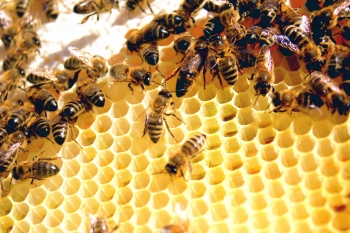 Growing up listening to Joni Mitchell songs, whenever I think of the heavy use of pesticides and herbicides, this line immediately comes to mind: “Give me spots on my apples, but leave me the birds and the bees, PLEE-EE-EE-EEESE!”
But song lyrics aside, a Rick Haney quote has stuck with me as I’ve read about the pollution issues that have become literally embedded in our soil and seeped through our waters: “Soil is not a chemistry set, it’s a biological system. We’ve treated it like a chemistry set because the chemistry is easier to measure than the soil biology” (https://orionmagazine.org/article/dirt-first/).
This is, of course, a long and nuanced conversation when it comes to agriculture – considering the real pressures that farmers face to produce high yields and continue to make a living in an industry with high risk, difficult demands, and large-scale corporate farming competition. One place where it seems pretty doable to treat the soil less like a chemistry set and more like a natural ecosystem is in the “backyard” of church properties. As congregations in our synod are coming together to care for the water, we are asked the critical question: “Is the water better or worse for the wear after it falls on this place where we gather for worship and community?”
When the rain comes, does it collect to nourish flowers and grasses that support bees and critters? Does it grow food that we use to feed the community? Does it green the grass and soak into the soil? As it runs off nonporous places like roofs, sidewalks, parking lots, what kinds of pollutants does it carry to the river and how can we minimize those negative affects?
As faith communities we have an opportunity with church properties to live into a vision beyond the status quo of over-using pesticides and herbicides to keep our grass green.
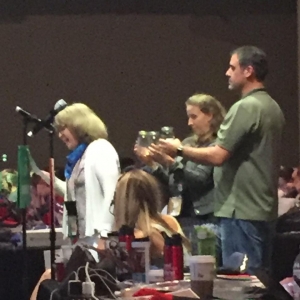 AT THE ELCA Churchwide Assembly, representatives of the Minneapolis Area Synod brought forward the same resolution that was passed at its own synod assembly this past spring – encouraging congregations to know their watershed address, to be aware of where their water comes from and where it flows to. It’s a call to better understand and steward this resource that we rely on for life – that also flows through our scriptural narratives and over our heads in baptism, marking us as beloved children of God.
Pastor Chris Chiles, one of the leaders in the synod’s EcoFaith Network of earth-stewards, brought three jars of water to the stage as she spoke to the importance of caring for the water as people of faith. All three contained Mississippi River water – one from the headwaters, one from the water as it flows through the Twin Cities, and one from the Mississippi in New Orleans, where the assembly was gathered, not far from where the river meets the gulf. The difference in the quality of the water was dramatic. Our waters are hurting.
So what does this have to do with our church lawns? Well, each plot of land is integrally connected to the larger watershed, and we have opportunities and challenges in mitigating our water’s pollution as every time the “heavens open up” and the rain falls. As faith communities we have an opportunity to live into a vision beyond the status quo of over-using pesticides and herbicides to keep our grass green. We get to ask the question, what does it mean to truly be a good neighbor and model good stewardship? Caring for our properties while cutting down on use of chemicals like pesticides and herbicides is just one such response.
But quick, before visions of dandelion fields and creeping vines overtaking whole buildings, let me assure you “sustainable lawn” does not have to mean “neighborhood weed patch,” as the U of M Extension SULIS team is quick to point out. There’s a lot of good study and strategy behind sustainably dealing with lawns and grasses that keep significant weed infestation to a minimum. The key is understanding the exposure/habitat of the space, knowing what kind of grass will succeed there, keeping a thick cover to keep weeds out (the greatest cause of weeds is actually stressed or thin grass), and embracing a bit of diversity in the grass.
Below are a couple of good resources in reading up on how to understand and care for your green space while using minimal to no herbicides. Though you don’t need to stop there – the synod will be hosting a workshop on sustainable lawn care at our next Toolkit for Congregational Leaders on Saturday November 5. Come and join us!
http://www.extension.umn.edu/garden/landscaping/maint/weed.htm
https://www.pca.state.mn.us/sites/default/files/p-tr1-04.pdf
 By Rev. Deb Stehlin, Director of Evangelical Mission
 By Rev. Craig Pederson, Assistant to the Bishop
 By Pastor John Hulden, Assistant to the Bishop
 rather he asks on behalf of a friend who is in need and is hungry. He acts out of love for a neighbor, responding with urgency to the particular need.
 This kind of persistence is critical in organizing for justice. It’s founded in relationship and it’s used intentionally to get results. Do we care enough to put pressure on those we know can help – for the sake of building a bridge and meeting a need? Can we strategically and passionately refuse to shirk away quietly but rather lift our voices and make noise until our friend is roused from sleepiness to share the resources they have that another is lacking?
 By Bob Hulteen, Director of Communications and Stewardship